
Forming Parabol’s Design Team
Background
Building a design team at Parabol has been a highlight of my career. I enjoyed working alongside the designers to develop our practice, support professional development, and ship great work together. There are several practices I’ll highlight here:
- Hiring with high standards
- Defining a design team charter
- Leveling, performance reviews, and transparent salaries
- Developing a cross-functional design practice
- Leading the company with design sprints

Hiring with high standards
Our north star for hiring centered on a culture of meaningful work and healthy working relationships. Two practices stand out from our process:
First, we gave more weight to our culture interview than our fit-for-role interview. Candidates and a group of Parabol employees would exchange cultural questions in advance. This gave us more time to think about these topics ahead of our discussion. From our side, we based our questions on our purpose and values.
Second, we had a trial project called “Batting Practice” allowing candidates to work on real projects with our team. They had a project brief, dedicated Slack channel, and got paid a fair contract for their work. This gave us a sense of what it would be like to work together.

Defining a design team charter
We held a workshop together to explore our mission and values as a team. While we didn’t require this early on, the process allowed us to take greater ownership of our work. Here’s the latest iteration of what we defined together:
Purpose
Our purpose is to bring to life Parabol’s mission of enabling meaningful interactions at work through the creation of innovative experiences that deliver value and delight our customers.
Values
Clarity Over Cleverness
We value quality over quantity, simplicity over complexity, and clarity over cleverness. We aim to achieve a level of clarity that removes any layers between our customers and their goals.
1000 Napkin Sketches
We draw ‘1000 napkin sketches’ i.e. we are generous with raw ideas. We encourage exploring different directions early and often. We keep in mind the sunk cost fallacy of holding onto our ideas.
Quality of Craft
We care for our craft in a way that shows how much we value the relationship with our customers. While we want our quality to be high, we value shipping good even over perfect and learn to navigate trade-offs.
Deep Work
We make the space for broad exploration, creative experimentation, and deeper development of skills. Saying yes to what’s important means saying no to many other things.
Feedback
We value learning if and how our concepts are helping our customers. We value hearing from others to further temper our ideas. We learn from each other how to become better at our craft.

Leveling, performance reviews, and transparent salaries
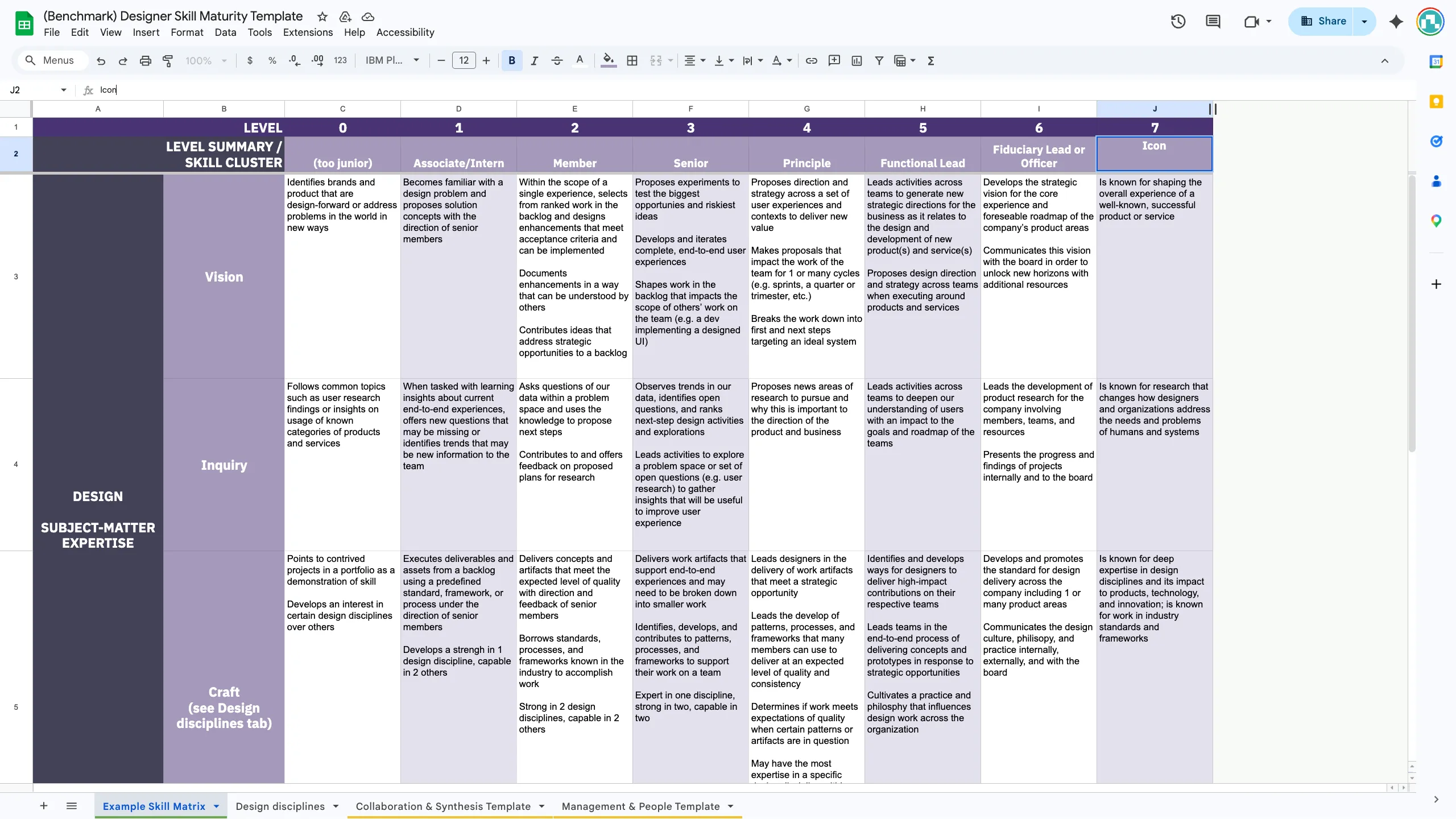
As a leadership team, we each defined a leveling framework for our functional discipline. Each matrix included a shared set of compentencies for all roles at the company. We finalized these policies with our teams using our governance process of proposals, feedback, and agreement by consent.
We built a workflow for performance reviews, leveling, and sub-leveling. Each involved a cross-functional panel of peers and managers who worked closely with the individual. The goal was to acknowledge where the teammate was growing, and identify opportunities to level up.
As a leadership team member, I sponsored a policy for transparent salaries that we drafted and proposed as a design team. This was centered on salary research and aligning our design and design leader levels with the data. In this way we made sure compensation was tied to level and experience, not to negotiation or bias.
Read more:
Here’s a look at our leveling matrix.

Developing a cross-functional design practice
Design was embedded in the business from left to right, across the customer journey.
- Growth & Marketing: from social media and ads to landing pages and content, we made every effort to ensure our brand, voice, and message were consistent. We helped potential customers find a right fit with Parabol, and learn about better teaming along the way.
- Product & Engineering: we were embedded in product squads working with engineers, data scientist, dev-sec-ops, and product management. We led with design sprints, built alongside engineers, and maintained a backlog for quality.
- Sales & Customer Success: we partnered with these teams to learn more about serving our customers’ problems, needs, and wishes. As needed, we set up user research projects to tackle tough problems.
A number of activities were key to our practice:
Async video sharing
We had a culture for sharing work early and often when we were at a stopping point or wrestling with an open question. We used Loom to record quick videos and get feedback from other roles.
Sync design reviews
Every sprint we held a video call where anybody could join and review the latest work for that sprint. This way we incorporated feedback from across the company, and everybody had a better sense of what was being shipped in the product.
Coaching with 1:1s
I get a lot of joy out of coaching others on the team. Our designers were great at being self-aware, honing their craft, and leading the way in may areas. We identified opportunities for building the company, the product, the team, and each other.
UX quality backlog
We maintained a backlog focused on usability, accessibility, and consistency. Each sprint we reviewed our backlog and committed to working on items during our sprints. We also used these check-ins to identify improvements to our practice.
Read more:

Leading the company with design sprints
My favorite experiences at Parabol, bar none, were our team retreats. We approached each team retreat as an opportunity to do deep work together and to strengthen our relationships with one another. Our process was similar to the Google Design Sprint approach.
We explored some great locations along the way:
- Brooklyn, New York
- Los Angeles, California
- Oaxaca, Mexico
- Mérida, Mexico
- Paros, Greece
- Lisbon, Portugal
- Austin, Texas
- San Diego, California
- Miami, Florida
Read more:
Lessons Learned
- There is no one-size-fits-all approach. The design practice should be developed over time as you navigate the context of your company, product, services, and work.
- The team will take ownership when they are involved in defining the mission, roles, and practice. This is key to developing talent and leadership.
- Embedding design practice across the company should be a priority to leaders. The customer journey gets better by collaborating with the teams that lead each touchpoint.
A great deal of appreciation is in order to the dedicated & talented design team. We did this together.
Illustrations by Frederique Matti